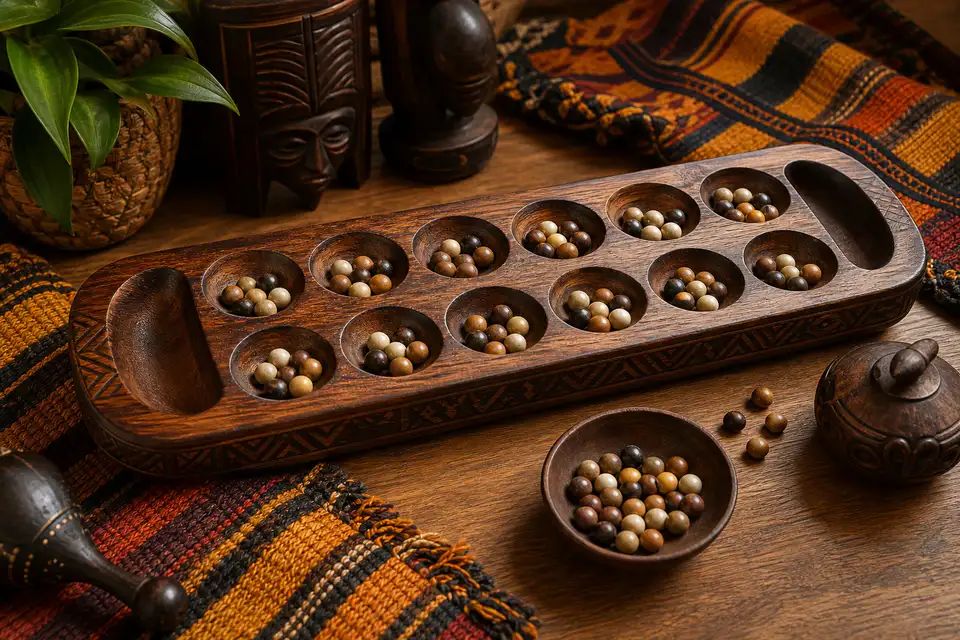
Oware strategy starts before the capture
A beginner sees Oware as a capture game. An improving player sees it as a board-flow game where captures are only the visible ending of a longer setup. The real decision starts before you touch a house: where will the last seed land, and what count will it create?
That question matters because Oware captures only from the opponent's side when the final seed makes a house contain exactly two or three seeds. The target is not "the biggest pit." The target is a count that becomes scorable after your sowing route ends.
Read the Oware / Awale rules guide first if the move sequence is still unclear. This page assumes you already know the basic rule and now need a practical way to choose moves without turning every position into a guess.
Principle 1: feeding comes before greed
The feeding rule is the strategic heart of Oware. If your opponent has no seeds, you must give them seeds when you can. That means a move can look profitable and still be wrong or illegal under the rules you are using.
For beginners, this changes the order of thinking. Do not start with "how many can I capture?" Start with "will the opponent still have a legal reply?" If the answer is no, your attractive capture may vanish or need a different treatment depending on the platform.
That does not make Oware gentle. It makes Oware exact. You are trying to win while keeping the game playable, and the player who understands that tension usually makes fewer dramatic mistakes.
Experienced player question: after my capture, can the opponent still move, and if not, did I have a feeding move available?
Principle 2: tempo exists without stores
Kalah teaches obvious tempo because landing in your own store can give another move. Oware does not work that way. There is no sowing store that gives an extra turn, so tempo is quieter.
In Oware, tempo means controlling the next useful reply. A move has tempo when it forces the opponent to feed you, breaks their capture chain, or leaves them with one uncomfortable route while your own targets improve.
Look at heavy houses and empty houses together. A loaded house can travel far enough to change several counts. An empty or low house can become a timing square. You are not racing to a store; you are shaping the next two or three landings.
Principle 3: build twos and threes, not just moves
The best beginner improvement is to scan opponent houses with one or two seeds. One can become two. Two can become three. Those are the houses that may score if your final seed lands there.
Then look backward from the target. If the house behind it also has two or three seeds after the move, the capture can chain. This is where many beginners miss value: they see the front capture but not the second house behind it.
Do not force the chain if it breaks feeding. A large capture that empties the opponent's side may fail under the ruleset. Treat every chain as a proposal, then check whether it leaves a playable board.
Feeding and capture decision table
Use this table before late or tactical moves. It is not a solver. It is a checklist that prevents the most common beginner errors: taking an illegal-looking capture, missing a chain, or feeding the opponent a better counter-capture.
| Position sign | Beginner question | Likely good habit | Common mistake |
|---|---|---|---|
| Opponent has no seeds | Can I feed them with any legal move? | Find the feeding move before considering captures. | Trying to win by leaving the opponent unable to move. |
| Opponent house has 1 or 2 seeds | Can my last seed land there? | Count the sowing route and target the final landing count. | Moving the largest house without checking the landing point. |
| Several opponent houses have 2 or 3 seeds | Does the capture continue backward? | Check adjacent houses behind the landing house before moving. | Taking a one-house capture and missing the real chain. |
| Grand-slam-looking capture | What does this platform do if all opponent seeds are taken? | Check the ruleset and avoid universal claims. | Assuming every Oware board treats grand slam the same way. |
| Low-seed endgame | Who collects or controls the remaining seeds? | Count score, remaining houses and legal feeding options together. | Playing a pretty capture after the endgame arithmetic is already decided. |
Starvation traps beginners should recognize
A starvation trap is not a magic trick. It is a situation where one side has so few seeds that every move must be checked against the feeding rule. The trap often works because a player sees a capture and forgets the board after the capture.
Watch for positions where the opponent has one seed, no seeds, or only a single loaded house that will soon empty. These positions are not only tactical; they are legal-pressure positions. You may need to feed, delay, or avoid taking the obvious chain.
Use careful language here. Oware strategy is not about leaving the opponent helpless as a slogan. It is about understanding when starvation rules restrict both players. The player who sees that restriction first usually controls the next practical choice.
Endgame counting: 25 wins, 24 draws
With forty-eight seeds in the common setup, twenty-five captured seeds are enough to win. If both players finish with twenty-four, the game is drawn. That simple score target should shape your final decisions.
Near the end, count captured seeds and board seeds together. A move that wins two seeds may be poor if it gives the opponent a legal chain worth more. A move that scores nothing may be strong if it forces the opponent to feed into your final target.
Endgames can also depend on platform or ruleset handling of cycles, no-legal-move states and grand-slam situations. For casual online play, the practical habit is enough: check the board's rule behavior and do not assume one universal Oware ending across every site.
A six-move practice drill
One slow game is better than ten automatic games. Open a board, play six serious moves, and write down one sentence before each move. The sentence should name the landing house, the target count and whether the opponent remains fed.
- Move 1: count the final landing house before touching seeds.
- Move 2: mark one opponent house with one or two seeds as a possible target.
- Move 3: check whether a capture would continue backward.
- Move 4: ask whether the opponent would still have seeds after your best-looking capture.
- Move 5: choose one quiet move that improves a future target.
- Move 6: classify the first mistake as counting, feeding, chain, tempo or endgame.
After the drill, stop reviewing. Do not turn practice into a long confession. Carry one correction into the next game, then repeat the same six-move structure.
What to practice on Toguz Arena
Use the Oware board on Toguz Arena as a practice target, not as a shortcut. This article does not embed a board; it keeps the strategy lesson crawlable and sends you to the live board only when you are ready to test the idea.
If bot play is useful for repetition, start with the Oware against the computer article and play short sessions. Then return to this strategy page and ask which error repeated most often.
If you want more context, use the Oware article hub and the Oware organizations and tournaments page. They help separate platform practice from broader Oware culture and rule communities without claiming that Toguz Arena is an official rules authority.
How Oware strategy differs from Kalah strategy
Kalah rewards store race, bonus turns and empty-pit captures. Oware rewards target counts, feeding discipline and chain timing. The boards may look related, but the beginner mistakes are different.
If you come from Kalah, do not chase the biggest immediate score. Ask whether the move keeps the opponent fed, whether a chain survives the ruleset and whether your next target gets better. If you want the comparison layer, read Kalah vs Oware after playing a few slow Oware games.
The broader mancala rules family guide is useful when game names blur together. Strategy becomes clearer when each variant keeps its own core rule: stores for Kalah, feeding for Oware, treasury/capture timing for Mangala and long nine-pit structures for Togyz-style games.
Sources and fact-check notes
- Toguz Arena: Oware / Awale rules - internal source-backed rules page for setup, sowing, captures, feeding, grand slam caveats and scoring.
- PlayStrategy: Oware rules - platform rules reference for Oware mechanics and implementation caveats.
- Aualé / Joan Sala Soler: how to play Oware - dedicated guide for Oware setup, sowing, capturing and endgame basics.
- Oware Society: Abapa rules - Abapa rule reference used with the HTTP URL verified in the earlier source packet.
Limit: this article teaches beginner strategy under common Abapa-style Oware assumptions. Always check the exact platform, club or tournament rule set for grand slam, cycle and endgame handling.