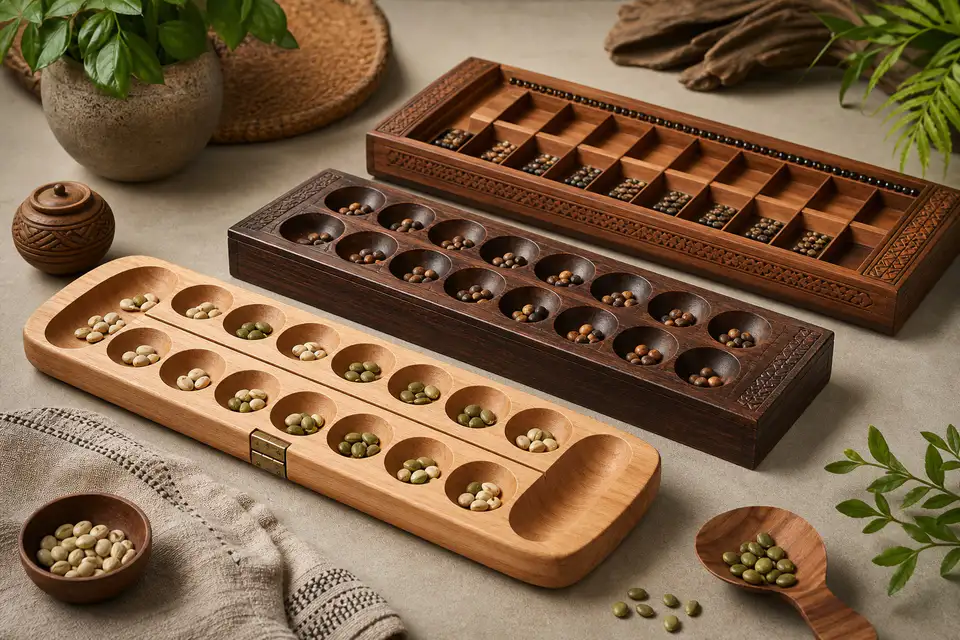
You want a physical board. Here is what actually matters.
A mancala board is not about luxury first. It is about function. You need pits deep enough to hold seeds without spilling, a surface that lets the hand sow smoothly, and stones or seeds that are comfortable to pick up one by one.
The board must match the game. Kalah usually needs a 6x2 layout with two stores. Oware also uses twelve houses and 48 seeds, but captured seeds can be kept aside, so stores are not part of the movement. Togyz Kumalak needs nine pits per side and 162 stones. Turkish Mangala uses twelve small pits and storage wells with 48 stones in the common modern rule set.
That is the buyer's first filter: rules before ornament. A beautiful board that does not fit your variant becomes shelf decor. A plain board with the correct pit count can become the board your family, club, or classroom actually uses.
What to look for in any mancala board
Layout: Count the pits before you buy. A 6x2 board can cover many beginner and family variants, but it cannot become a real 9x2 Togyz Kumalak board. Pieces: Confirm the count in the listing: many Kalah and Oware setups use 48 pieces, while Togyz Kumalak needs 162. Pit shape: Deeper, rounded pits are easier for fast sowing than shallow decorative cups.
Material: Wood feels traditional and tends to age well. Plastic and resin can be practical for schools, travel, or outdoor play. Glass beads look clear on a table, but beans, pebbles, shells, or counters can work if they are similar in size and easy to count.
Portability: A foldable board is useful only if it closes securely and stores the pieces without rattling out. For a classroom, durability and replacement counters matter more than carved detail. For a cultural gift, craftsmanship and variant accuracy matter more than compact storage.
Buyer matrix: choose by variant, not by marketplace title
| Use case | Better board choice | Check before buying | Source route |
|---|---|---|---|
| Family starter game | 6x2 Kalah-style board with stores | 12 small pits, 2 stores, 48 counters, stable hinge if foldable | Kalah board rules |
| Oware / Awale practice | 6x2 board with 48 seeds; stores optional | Do not assume Kalah store rules apply to Oware | Oware rules |
| Togyz Kumalak / Toguz Korgool | 9x2 board with two kazan zones | 162 stones, readable pits, enough room for larger captures | Togyz Kumalak rules |
| Turkish Mangala | 6x2 board with storage wells | 48 stones and pits that remain readable under decorative inlay | Mangala source notes |
| Classroom or travel | DIY egg carton, printed board, bowls, or washable counters | Cheap replacement pieces and a setup that students can reset quickly | Classroom kit |
Kalah boards: mass-produced is often enough
Kalah boards are the easiest physical mancala boards to find because the family version is widely sold as "mancala" in toy and game shops. The important checks are simple: two rows of six pits, one store at each end, and 48 pieces for the standard four-per-pit setup.
Do not overpay for a beginner Kalah board because the box says "ancient strategy game." Pay for practical details: pits that do not spill, stones that fit adult and child hands, a hinge that lies flat, and a case that does not dump the pieces into a bag every time you move it.
For teaching or travel, a modest foldable board can be better than a heavy display board. For a family table, choose the one that people will leave out and play. The buyer question is not "which looks richest?" It is "which one will survive twenty quick games?"
Oware boards: West African tradition, different movement logic
Oware looks close to Kalah at first glance because many boards use two rows of six houses. The movement logic is different enough that a store-heavy Kalah mindset can mislead beginners. In Oware Abapa, captured seeds are removed from play or kept aside; the end stores are not part of the sowing path.
That changes what you should buy. A board with twelve clear houses and 48 similar seeds is more important than a board with oversized end bins. If the board has end cups, treat them as scoring areas, not as movement spaces.
If you are buying an artisan Oware board, look for clarity as much as carving. Decorative work is welcome, but the houses should remain readable during a crowded position. Experienced players count and guard seed totals; a confusing board hurts the game.
Togyz Kumalak boards: do not force it onto a 6x2 board
Togyz Kumalak is the point where a generic mancala board stops being enough. The game needs nine pits per side and a total of 162 stones. A 6x2 Kalah or Oware board can teach the idea of sowing, but it cannot host a proper Togyz Kumalak game.
Look for two rows of nine pits, two kazan areas, and enough stones to start with nine in every small pit. Deep pits help because captures can become large, and readable pit counts matter when players are judging parity, tuzdyk threats, and long sowing routes.
If a listing calls itself "Togyz Kumalak" but shows only twelve small pits, treat that as a red flag. It may be a generic mancala board using a broad keyword. Variant accuracy matters more than the title of the listing.
Mangala boards: decoration should not hide usability
Turkish Mangala boards often lean decorative: carved wood, painted surfaces, inlay work, or gift-box presentation. That can be part of the appeal. Still, the board needs to remain a playable 6x2 surface with storage wells and 48 stones for the common modern setup.
Before buying a decorative board, check the practical parts: are the pits large enough for four stones at the start and more later? Are the storage wells easy to reach? Can two players sit comfortably across from each other without the board becoming a display object instead of a game?
For casual players, the best Mangala board is often the one that balances cultural look with a clear playing surface. Mother-of-pearl or marquetry is attractive; unreadable pits are not.
The DIY route: good enough is often better than delayed
You do not need to buy a board before you learn the game. A printed board, an egg carton, a muffin tin, twelve small cups, or two rows of circles drawn on paper can be enough for first play. Use beans, buttons, glass beads, pebbles, or counters as long as they are easy to move and count.
DIY is especially useful for classrooms. It lets a teacher test whether the group understands sowing and capture before spending money on physical sets. It also makes lost pieces less stressful: a missing bean is not the end of the lesson.
The limitation is variant fit. DIY works well for Kalah or Oware. For Togyz Kumalak, you need more pits and many more stones, so a quick classroom prototype must be planned more carefully.
How to evaluate listings without trusting sales copy
Marketplace titles often use "mancala" as a broad label. That is normal, but it means the buyer has to verify the actual board. Do not rely on "traditional," "deluxe," "African," "Kazakh," or "Turkish" as proof that the rules match your intended game.
Use this quick check before buying:
- Count the small pits in the photos.
- Confirm the piece count in the description.
- Check whether stores are part of the rules or just scoring cups.
- Look for photos with pieces inside the pits, not only an empty board.
- Check current shipping, returns, and availability on the seller page before purchase.
Do not treat this article as a live price list. Prices, inventory, shipping, and seller quality change. This guide is a selection checklist, not an affiliate ranking or current marketplace audit.
While waiting for your physical board, you can use Toguz Arena as a rules and practice route: read the mancala family guide, compare variants, and try online play before deciding which physical board deserves space on your table.
Sources and buyer limits
This buyer guide uses rules and setup sources only to verify board requirements. It does not verify live seller inventory, current prices, shipping, or authenticity claims.
- OSPI Mancala Rules PDF - Kalah-style 12-pit setup, stores, and 48 counters for a classroom-friendly rules sheet.
- PlayStrategy Oware rules - Oware board and seed-count reference for online play.
- Astana Times on Togyz Kumalak ICH listing - 9x2 board, kazan zones, and 162 stones.
- Daily Sabah on Mangala - modern Mangala setup with 48 stones, twelve pits, and storage wells.
- Toguz Arena classroom kit - practical route for printable or low-cost classroom play.
Frequently Asked Questions
What is the best mancala board for beginners?
For most beginners, a clear 6x2 Kalah-style board with two stores and 48 counters is enough. It is easy to understand, works for family play, and can also introduce the difference between Kalah and Oware. Check the current listing photos and piece count before buying.
Can I use the same board for different mancala variants?
A 6x2 board can support Kalah, Oware, and many Mangala-style lessons if players understand which stores matter for each rule set. It cannot replace a Togyz Kumalak board, because Togyz needs nine pits per side and 162 stones.
Should I buy an artisan mancala board?
Buy an artisan board when craftsmanship, cultural presentation, or a gift object matters. For daily play, usability still comes first: correct layout, readable pits, enough pieces, smooth sowing, and a stable surface.