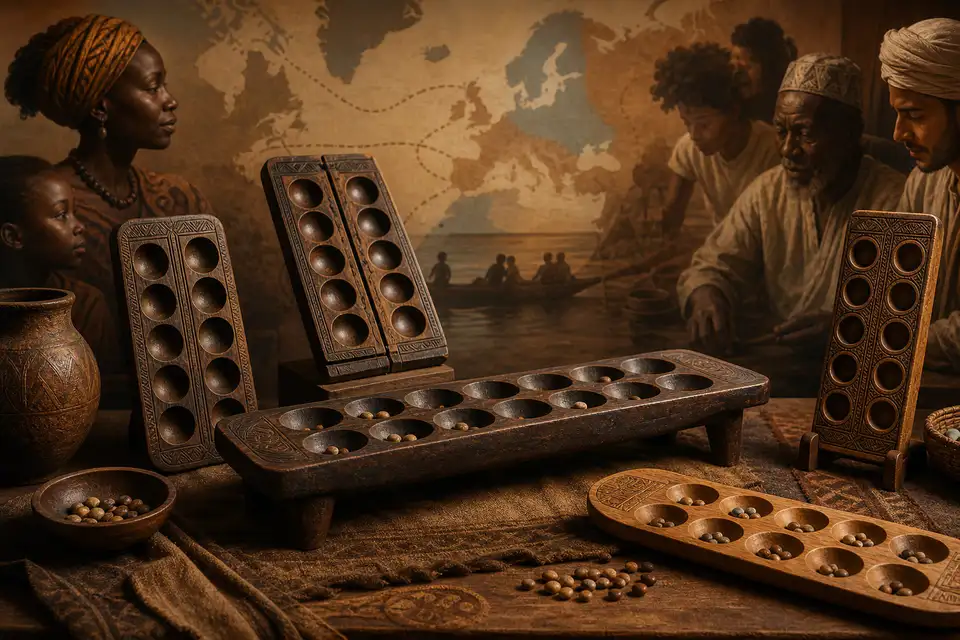
Mancala culture is real, but it is not one story
The safest way to write about mancala is to treat the family as a network of local games. Togyzqumalaq, Toguz Korgool, Mangala, Oware, Bao, Sungka and Congklak do not share one single origin story, one universal rulebook or one cultural role.
Some games are tied to formal heritage institutions. Some are maintained through clubs, families, schools, community groups or online platforms. Some cultural details are well documented; others appear in local memory, tourism copy or unsourced summaries and should be handled as claims, not settled facts.
For readers, the practical lesson is simple: learn the rules first, then read culture with source labels attached. That keeps the game interesting without turning folklore into false certainty.
Source-status table: what can be said safely
| Topic | Source status | Safe wording | Do not overstate |
|---|---|---|---|
| Togyzqumalaq, Toguz Korgool and Mangala/Gocurme | UNESCO ICH listing page identifies the multi-country inscription on the Representative List in 2020. | These games have documented intangible-heritage recognition. | Do not claim UNESCO endorses Toguz Arena or that every mancala variant has the same status. |
| Oware | The Oware Society documents Oware's Ghana/Akan naming, social role, rules and modern play. | Oware has a strong public community and social-play tradition. | Do not universalize every village, school, Caribbean or oral-tradition claim without a local source. |
| Bao | Public rule sources describe Bao through four-row boards, named phases and local rule versions. | Bao is useful as a four-row East African comparison point. | Do not call it "the game of kings", cite a proverb, or name championships without exact sources. |
| Sungka / Congklak / Congkak | Scholarship and public summaries support regional comparison, but local rules and customs vary. | These are Southeast Asian mancala-family games with local names and boards. | Do not turn population size, festival use, school use or ritual claims into universal facts. |
| Modern online play | Toguz Arena supports selected playable variants; other platforms and communities cover different games. | Online play can preserve and teach supported rules, but it is not a substitute for all local traditions. | Do not say every game in the mancala family is available online or on Toguz Arena. |
UNESCO recognition: a documented heritage anchor
The strongest public heritage source for this site is the UNESCO inscription for "Traditional intelligence and strategy game: Togyzqumalaq, Toguz Korgool, Mangala/Gocurme." The listing names Kazakhstan, Kyrgyzstan and Turkiye and places the element on the Representative List in 2020.
This matters for reader trust and discovery because it creates a clear entity relationship: Togyz Kumalak / Toguz Korgool / Mangala are not just generic board-game keywords; they are named cultural entities with documented heritage context.
Keep the limitation visible. UNESCO recognition is not a product endorsement, not a claim about every mancala game, and not proof that every historical or educational statement about mancala is true.
Oware: social play with a community source layer
Oware is a strong example of a mancala game with a visible social and community layer. The Oware Society presents it as a two-row pit-and-pebble game associated with Ghana/Akan naming and documents rules, social role, geographical spread and contemporary developments.
That is enough to say Oware has a public social-play tradition and a modern organizational footprint. It is not enough to write cinematic claims about every Ghanaian village, every Caribbean family or every oral-tradition pathway unless the page cites a source for that exact place and claim.
If you want to understand how Oware plays rather than only where it belongs culturally, start with the Oware rules guide and then compare the broader institutional layer in Oware organizations and tournaments.
Mangala and Central Asian games: related, not interchangeable
Mangala, Togyzqumalaq and Toguz Korgool sit close together in the UNESCO heritage entry, but the rules and regional contexts should still be described separately. Mangala is not simply Kalah in Turkish clothing, and Togyz Kumalak is not just "mancala with more pits."
This distinction helps readers and search engines. A page about Mangala should mention Turkish source context and the modern game name. A page about Togyz Kumalak should explain the 9x2 board, tuzdyk, kazan and Central Asian terminology. A cultural overview can connect them, but it should not flatten them.
For source-backed next steps, use the Mangala organizations guide, the Togyz Kumalak rules guide, and the broader source hub.
Bao, Sungka and Congklak: culture needs local precision
Bao, Sungka and Congklak show why broad cultural writing can become risky. They are useful comparison points because they show different board shapes, regional names, materials and rule traditions. They are not proof that all mancala games share the same history.
Bao should be described through source-backed rules and East African context rather than unsupported superlatives. Sungka and Congklak can be discussed as Southeast Asian mancala-family games, but local customs and names need careful sourcing before they become strong claims.
For a safer overview of those names, read the rare Mancala variants guide and the dedicated Bao rules and context guide.
Digital play: preservation, practice and limits
Online platforms can help preserve rules by making them playable, searchable and teachable. Toguz Arena gives players a browser path into supported mancala-family games such as Togyz Kumalak, Kalah, Oware, Mangala and Bestemshe. That is useful for practice, discovery and internal linking from culture pages to rule pages.
Still, digital play has limits. It can teach a ruleset and help players review decisions, but it cannot replace local language, local boards, family customs, school programs, clubs, festivals or federation structures. A good cultural article should send readers to both practice routes and source routes.
Use the culture page as a bridge: read the source notes, choose a variant, then move into complete Mancala family rules or online play options.
Sources and fact-check notes
This article intentionally avoids exact age claims, population counts, prize pools, named proverbs, school-adoption claims and festival claims unless a source is attached. Treat it as a source-backed orientation page, not a full ethnographic history.
- UNESCO ICH: Togyzqumalaq, Toguz Korgool, Mangala/Gocurme - official heritage entry for the multi-country inscription.
- The Oware Society: Information - community source for Oware history, rules, social role and contemporary developments.
- Philippine Sungka and Cultural Contact in Southeast Asia - scholarly source for Sungka context.
- The Game Cabinet: Bao rules summary - practical Bao rule outline and version caveat.
- Toguz Arena source hub - internal route to official federation and heritage links used elsewhere on the site.
Frequently Asked Questions
Is mancala 7,000 years old?
Some public summaries use very old age claims for pit-and-pebble games, but this article does not assert an exact age for the whole mancala family. Exact chronology needs archaeological and scholarly sources, and different games have different evidence trails.
Which mancala games have UNESCO recognition?
The official UNESCO ICH entry used here is for Traditional intelligence and strategy game: Togyzqumalaq, Toguz Korgool, Mangala/Gocurme, inscribed on the Representative List in 2020. Do not extend that status to every mancala game.
Does online play replace local cultural practice?
No. Online play can teach rules and connect players, but local cultural practice also includes language, boards, clubs, families, schools, events and organizations. Use both routes: practice online and read source-backed cultural context.